

Mad Honey – Wild • Psychoactive • Authentic
Mad honey is a natural honey produced by bees that collect nectar from wild rhododendron flowers found in the high mountain regions of Nepal, Bhutan, India, and Turkey. Unlike regular honey, mad honey naturally has small amounts of compound called grayanotoxin, which comes from these rhododendron flowers.
For centuries, mad honey has been known in mountain communities and is recognized for its rarity, natural origin, and distinct characteristics compared to ordinary honey.
WHY IS IT CALLED MAD HONEY?
The name “mad honey” comes from its unusual and distinctive effects on the human body when consumed in certain amounts.
Unlike regular honey, it has natural bio-active compounds that can influence the nervous system. When consumed in very small to moderate quantities, people may experience:
- Relaxation and warmth
- Light dizziness or lightheaded
- Lowered blood pressure
- Slower heart rate (bradycardia)
However, larger amounts can be unsafe and may cause the following:
- Nausea and vomiting
- Weaknesses and fatigue
- Severe drop in blood pressure
- Blurred vision
- Irregular heartbeat (in rare cases)
These effects are linked to compounds naturally present in rhododendron nectar.
WHAT CAUSES THESE EFFECTS?
The main cause is grayanotoxin, a naturally occurring compound (neurotoxin) found in the nectar and pollen of certain wild rhododendron species (Rhododendron ponticum, Rhododendron luteum and Rhododendron arboreum- laliguras). It affects the nervous system by interfering with sodium channels in cells, which disrupts normal nerve and heart function.
Even though it is sometimes marketed as a “natural medicine honey”, Mad Honey should never be consumed without caution, as its effects vary depending on dose and source.
ORIGINS: WHERE MAD HONEY COMES FROM ?
Mad Honey thrives mainly in the high mountains of Nepal, where a rare natural cycle to exist.
High-altitude Himalayan landscapes are remote and largely untouched by modern agriculture. This allows wild rhododendron forests to grow freely by creating the perfect environment for Mad Honey production.
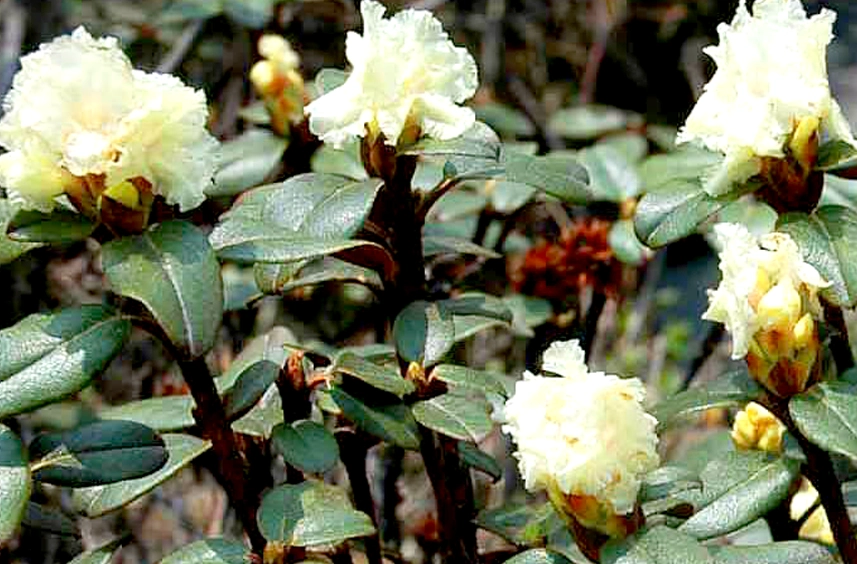
Wild Himalayan bees collect nectar from these flowers, and the pristine mountain ecosystem helps preserve the honey’s natural purity. The combination of altitude, biodiversity, and the traditional harvesting makes Nepal one of the world’s most authentic sources of Mad Honey.
Mad Honey thrives mainly in the high mountains of Nepal, where a rare natural cycle to exist.
High-altitude Himalayan landscapes are remote and largely untouched by modern agriculture. This allows wild rhododendron forests to grow freely by creating the perfect environment for Mad Honey production.
Wild Himalayan bees collect nectar from these flowers, and the pristine mountain ecosystem helps preserve the honey’s natural purity. The combination of altitude, biodiversity, and the traditional harvesting makes Nepal one of the world’s most authentic sources of Mad Honey.
BEES AND NATURAL ECOSYSTEM BEHIND MAD HONEY
At the center of this ecosystem is the giant Himalayan honeybees, Apis laboriosa, the largest honeybee in the world. These remarkable bees thrive in extreme high-altitude environments where very few insects can survive.
Unlike domesticated honeybees, they build enormous hives on steep vertical cliffs, often hundreds of meters above the ground. Living in thin mountain air and harsh weather conditions, they travel long distances across remote forests to gather nectar from wild rhododendron flowers.
This challenging habitat and rich floral diversity influence the behavior of these bees and the unique characteristics of the honey they produce. The rare combination of high mountains, wild rhododendron forests, and cliff-dwelling bees creates a natural balance that cannot be replicated through modern farming or controlled beekeeping.
HISTORY AND CULTURAL SIGNIFICANCE IN NEPAL
Mad Honey has been a part of Himalayan life for centuries, especially in the remote mountain communities of Nepal. More than just a food, it represents tradition, heritage and a deep connection between people and their environment.
In the past, when modern healthcare was limited in remote villages, Mad Honey was valued as part of traditional folk medicine. Small amounts were used for pain relief, inflammation, and general wellness. Over generations, this knowledge was carefully passed down, becoming an important part of local healing traditions and community wisdom.
Mad Honey also holds cultural and spiritual meaning. In some Himalayan communities, it is shared or offered during special occasions and gatherings as a symbol of respect, gratitude and harmony with nature. The dangerous craft of harvesting honey from high cliffs is itself a respected cultural tradition, requiring teamwork, courage and deep knowledge of the mountains.
Ultimately, Mad Honey reflects the close relationship between Himalayan communities and their ecosystem. It represents not only survival, but also identity, co-operation and indigenous knowledge preserved across generations.
HONEY HUNTERS: THE GUARDIAN OF TRADITION
In Nepal, Mad Honey harvesting is carried out by indigenous mountain communities, particularly the Gurung and Magar people. For them, honey hunting is not just seasonal work but a cultural tradition that has been passed down through generations.
From an early age, hunters learn the skills, rituals and teamwork required for this demanding practice from their elders. Each harvesting season provides an important source of income for families living in remote Himalayan regions, where economic opportunities are often limited.
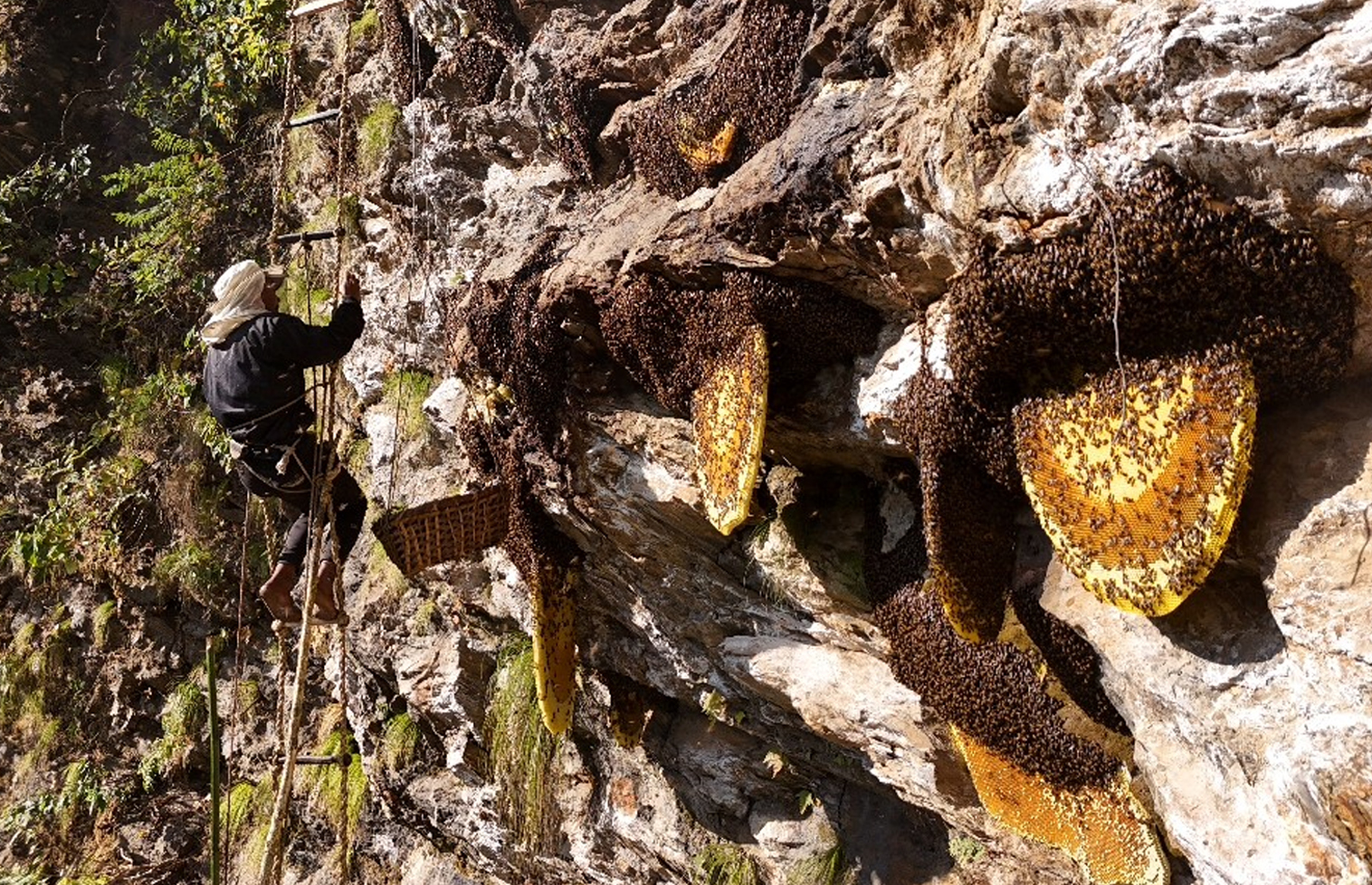
The harvesting process is both extraordinary and dangerous. Hunters climb steep cliffs using handmade rope ladders and traditional tools, sometimes suspended hundreds of meters above the ground. Despite the risks, they continue this ancient practice with deep respect for nature, their ancestors and the mountains they call home.
Today, honey hunting stands as a powerful symbol of cultural heritage, courage, and the enduring bond between Himalayan communities and their natural environment.
GEOGRAPHY AND HARVESTING SEASON OF MAD HONEY
Mad honey is mainly harvested from the mid and high-hill regions of Nepal, especially in districts like Lamjung, Myagdi, Kaski and Gorkha districts. These areas lie within the Himalayan foothills, where steep cliffs, dense forests and rich biodiversity create the perfect natural habitat for giant Himalayan honeybees.
These landscape plays a crucial role in the production of Mad Honey. The cliff provides safe nesting places for the bees, while the surrounding forests offer wild rhododendron flowers as it is the key nectar source which gives Mad Honey its unique properties. The combination of altitude, isolation and the untouched vegetation makes these places ideal for producing this rare honey.
The harvesting of Mad Honey is not done throughout the year. It depends heavily on natural cycles and seasonal changes.
WHEN IS MAD HONEY HARVESTED?
Mad honey is harvested only twice a year, making it highly seasonal and limited in supply.
SPRING SEASON (April to May):
This is the main harvesting period when rhododendron flowers bloom and bee activity is at its peak. During this time, honey production is at its most active stage.
AUTUMN SEASON (October to November):
This is the secondary harvesting season when weather conditions are stabilized, and honeycombs are mature enough to be collected.
The exact timing may vary slightly depending on altitude and local weather conditions in each region.
The main factors which influence harvesting are:
Flowering blooming cycles:
Rhododendron and other wildflowers bloom in specific seasons, directly affecting nectar availability.
Weather conditions:
Dry, stable weather is needed because hunters climb steep cliffs during harvesting.
Seasonal climate patterns:
Spring and autumn are the most favorable periods for both bee activity and safe harvesting.
–Because of these strict natural conditions, Mad Honey harvesting happens only a few times a year, making it rare, seasonal, and deeply tied to Himalayan tradition.
HOW IS MAD HONEY NATURALLY PRODUCED?
Mad honey is not something that is made in factories or carefully controlled farms. It is a rare natural product that forms only in very specific conditions found in the high Himalayas.
It begins with wild rhododendron flowers that grows in mountainous regions which produces nectar that hold natural active compounds. When giant Himalayan honeybees collect this nectar, those compounds become part of the honey. These bees carry nectar back to their cliff-side hives and store it in large honeycombs. Inside the hive, the nectar slowly turns into honey as moisture reduces and the natural compounds are still preserved.
As the honey matures in the cold, high-altitude Himalayan climate, it develops the unique characteristics “MAD HONEY”. Because this entire process depends on wildflowers, wild bees and the condition of the mountain, it cannot be produced artificially or on farms.
CLIFF HONEY HUNTING: Dangerous Harvesting Method
Cliff honey hunting is one of the riskiest ways of collecting honey in the world. The honey hunters work on tall, steep cliffs where giant Himalayan bees build their hives.
First, hunters search the mountains to find the bee colonies hanging on rock cliffs. These hives are often hundreds of meters above the ground.
Once the hive is found, the hunters build long rope ladders and simple rope systems by hand. These ropes are their only support while hanging in the air.
Before climbing, they light fires at the base of the cliff. The smoke rises and help calm the bees so that they become less aggressive.
Then the main hunter slowly climbs the rope ladder down the cliff. Hanging in the air, he uses a long stick or knife to cut the honeycombs carefully and collect them in baskets.
This work is extremely dangerous because hunters face high cliffs, risk of falling, thousands of stinging bees, strong winds, and rough weather.
Despite these risks, generations have passed down this traditional method and am still practicing today.
REASONS WHY MAD HONEY IS RARE AND EXPENSIVE !
Mad Honey is not an everyday product, it exists only in very specific natural and cultural conditions, which makes it both rare and costly. Here’s why:
Limited production regions
Mad honey can only be produced in certain Himalayan areas where wild rhododendron flowers grow at high altitudes. These flowers hold natural compounds that give the honey its special effects. Because this environment exists only in a few mountain regions, its production is naturally limited.
Seasonal Harvesting only
The honey is collected only twice a year (mainly in spring and sometimes in autumn). Outside these short harvesting seasons, there is no production which means the yearly supply is very small.
High risk during collection
Harvesting mad honey is very dangerous as honey hunters must climb the steep clips using handmade rope ladders and traditional tools. The process takes time, skill and courage, so during the expedition only small amount can be collected.
Wild Bee Population Limits
Mad honey is produced by wild Himalayan giant honeybees that build their hives on high cliffs. Unlike the regular honeybees, these bees cannot be easily farmed or kept in managed beehives. Their survival depends on natural factors such as weather, seasonal flower blooms, and overall, the entire health of mountain ecosystem. Also, the population of these bees cannot be controlled or increased by humans, the amount of Mad Honey they produce stays naturally limited.
Rising global demand
In recent years, Mad Honey has gained worldwide attention for its uniqueness, traditional use and its rare effects. As more and more people become curious about it, the demand obviously increases but the supply stays small. When demand rises and the supply is still limited, the price naturally becomes higher.
Therefore, Mad Honey is rare because it is hard to produce, dangerous to harvest, available only in small amounts and increasingly popular around the world.
THE SCIENCE BEHIND MAD HONEY
Grayanotoxins are the natural chemical compounds present in the nectar of certain rhododendron flowers that give Mad Honey its unique effects on the human body. When giant Himalayan honeybees collect this nectar and turn it into honey, the small amounts of these compounds remain in the final product.
SCIENCE AND EFFECTS OF MAD HONEY ON THE HUMAN BODY
Mad honey affects the human body in different way depending on the amount consumed. Its active compounds, called grayanotoxin, interact with the nervous system and influence how signals are transmitted between nerves and muscles. This can affect important functions such as heart rate and blood pressure, often leading it to drop when consumed.
In small amounts, mad honey generally produces a gentle calming effect where people may feel relaxed, slightly warm, mentally at ease, also light-headed sensation like mild dizziness.
At slightly higher amounts, its natural compounds affect the nervous system more strongly, which may result in altered feeling, light-headedness and a mild sedative effect.
When consumed in larger amounts, mad honey can cause uncomfortable or unsafe effects like nausea, stomach discomfort, dizziness, sweating, confusion and very low blood pressure, often making the body feel heavy or overly sleepy.
HEALTH BENEFITS OF MAD HONEY WITH ITS TRADITIONAL USES
In traditional Himalayan communities, Mad Honey has been used in small amounts for various wellness purposes. Locally, people believe it may help with mild pain relief, support overall well-being, and in some cases, can be used in traditional remedies related to blood pressure.
However, these uses come mainly from folk knowledge passed down through generations rather than strong scientific evidence. Modern research on its health benefits is still limited, so its effect is not fully proven in a medical sense. So, it is important to treat Mad Honey with caution and use it responsibly rather than relying on it as treatment.
SAFE CONSUMPTION AND AWARENESS
Mad Honey should be consumed in very small amounts and not used frequently. Its effect can vary from person to person, so its important to be careful and pay attention to how your body reacts. Over consumption may lead to unwanted side effects, so responsible use is essential.
WHAT CAN BE MADE FROM MAD HONEY?
Explored in traditional applications, its uses are very limited due to its strong natural compounds. Beyond common uses, it is sometimes featured in cultural rituals and traditional healing practices in Himalayan communities. In rare cases, it is also studied in research settings for its bio-active properties, especially related to grayanotoxin found in rhododendron nectar. It is occasionally used in small scale herbal preparations, traditional wellness practices, and small-scale experimental products, though these are still highly limited and are not commercialized widely.
TYPES OF MAD HONEY
Mad Honey is not the same everywhere. The effects, strength, color and taste depend on geography, climate and the flowers visited by bees. The two most well-known varieties come from Nepal (Himalayas) and Turkey (Black Sea region).
Let’s talk about Nepalese Mad Honey, a traditional variety of the Himalayas. This mad honey is the most famous and strongest form of mad honey in the world. It is harvested in high Himalayan regions by traditional honey hunters. Its sources are:
- Produced by giant Himalayan honeybees (Apis laboriosa)
- Bees collect nectar mainly from wild rhododendron flowers.
- Found in the remote mountain cliffs of Nepal.
Some of its characteristics are:
- Dark reddish or deep amber color
- Thick texture and strong aroma
- Rare and difficult to harvest.
Because honey is formed in extreme altitude conditions and from highly concentrated rhododendron nectar, the natural compounds become more potent.
Now let’s talk about Turkish Mad Honey, a black sea regional variant. It also produces mad honey, especially along the Black Sea coast. This variety has been used for centuries in small traditional doses. Some of its sources are:
- Produced by European honeybees (Apis mellifera)
- Nectar from rhododendron species native to Turkey
- Collected through conventional beekeeping methods.
And some of its characteristics are:
- Light amber or golden color
- Easier to harvest compared to Himalayan honey.
- More commonly available in local markets
Turkish mad honey is known historically and even mentioned in ancient texts but is generally less intense than the Himalayan variety.
KEY DIFFERENCES BETWEEN NEPALESE AND TURKISH MAD HONEY
Strength of effects
Nepalese Mad Honey
- Is considered very strong.
- Found in higher altitude with various other wild rhododendron species.
- Should be consumed in small doses.
Turkish Mad Honey
- Is typically milder.
- Effects are gentler and more predictable.
- Traditionally consumed in tiny doses as well
Color
Nepalese Mad Honey
- Dark red to deep amber
- Sometimes called “red honey.”
Turkish Mad Honey
- Light amber to golden brown
- Looks closer to normal honey.
Their color differences come from flower type, altitude and mineral content of the region.
Taste and Aroma
Nepalese Mad Honey
- Bitter-sweet flavor
- Strong herbal and floral notes
- Slightly smoky and earthy aftertaste
Turkish Mad Honey
- Sweet with mild bitterness
- More like regular honey
- Softer and smooth flavor
The stronger bitterness in Nepalese honey reflects its higher concentration of natural compounds.
Chemical Concentration
Both varieties have grayanotoxin, the natural compounds responsible for mad honey’s unusual effects.
Nepalese Mad Honey
- Higher grayanotoxin concentration
- Produced from wild Himalayan rhododendron species.
- Effects mab be stronger and long lasting.
Turkish Mad Honey
- Lower concentration
- Still active but milder
- More commonly studied in historical and medical contexts
MARKET VALUE AND GLOBAL DEMAND OF MAD HONEY
Mad Honey is considered a finest natural product because it is extremely rare and difficult to obtain. Unlike regular honey that can be produced in farms, Mad Honey is harvested only a few times a year from wild bee colonies living on steep Himalayan cliffs. The harvesting process is dangerous, time-consuming and requires skilled traditional honey hunters who climb high rock faces using handmade rope systems. Because the supply is naturally limited and harvesting cannot be scaled easily, the quantity available in the global market is still very small.
At the same time, international interest in unique natural products has grown rapidly. Consumers in wellness, alternative health and luxury food markets are increasingly curious about rare and traditional products with cultural stories behind them. Mad Hiney fits perfectly into this trend because of its unusual origin, traditional harvesting methods, and naturally occurring bioactive compounds. This rising curiosity has increased demand far beyond the regions where it is produced.
Another factor that increases its market value is the challenge of authenticity. Because genuine Mad Honey is scarce and expensive to collect, counterfeit or diluted versions sometimes appear in the market. Buyers often look for trusted sources and verified suppliers, which further raises the price of authentic products. In many cases, the rarity, story and exclusivity of Mad Honey make it feel more like a luxury specialty product than an everyday food.
For these reasons, Mad Honey has gained a strong reputation in global markets, where it is valued not only for its unique properties but also for the tradition, risk and rarity behind every jar.
LEGALITY, ETHICS AND SUSTAINABILITY
The trade of Mad Honey balances regulation, tradition, and environmental responsibility, with varying export rules requiring compliance with international and local guidelines. Ethical harvesting from wild cliff hives is crucial for maintaining healthy bee populations and forest ecosystems. Sustainable practices like seasonal collection and community-based management are essential to protect biodiversity and support the livelihoods of honey-hunting communities, ensuring the continued production of Mad Honey for future generations.
MODERN INFLUENCE AND TOURISM
Mad Honey has gained global attention, evolving from a niche Himalayan tradition to a widely discussed natural product due to documentaries and social media showcasing the perilous honey hunting process and its unique effects. This increased interest has sparked scientific inquiry into its natural compounds and positioned honey hunting as a cultural tourism attraction in Nepal, appealing to travelers seeking authentic experiences. Consequently, this visibility is benefiting rural communities by enhancing their recognition and creating opportunities for sustainable tourism and improved local livelihoods.
SUSTAINABILITY AND SUSTAINABLE DEVELOPMENT GOALS (SDGs) IMPACT
At National Organics, Mad Honey stands for more than a rare natural product, it is a pathway to meaningful and measurable impact. Through responsible sourcing and ethical partnerships, our work with Mad Honey directly supports rural livelihoods in remote Himalayan communities. By creating fair market access and stable income opportunities, we help honey-hunting families improve their quality of life while continuing their traditional way of living.
Our approach also prioritizes biodiversity protection. Mad Honey is produced within fragile mountain ecosystems that depend on healthy forests, thriving pollinators, and balanced seasonal cycles. By encouraging sustainable harvesting and conservation-focused practices, we actively support the protection of wild bee populations and the preservation of Himalayan flora.
Equally important is the preservation of indigenous knowledge. Honey hunting is a cultural heritage passed down through generations, and our mission is to help ensure that this tradition continues to be valued and sustained. By collaborating closely with local authorities, we support the continuation of ancestral skills while creating new economic opportunities.
Through these efforts, National Organics contributes to Eco-based local economies that balance environmental care, cultural respect, and long-term prosperity. Our Mad Honey initiatives align directly with global Sustainable Development Goals (SDGs), helping nurture people, protect the planet, and create sustainable growth for the future.
CONCLUSION
Mad Honey is far more than a honey. It is a remarkable meeting point of nature, culture, science and tradition. From the towering Himalayan cliffs where it is harvested to the growing global markets that value its uniqueness, Mad Honey tells a story of human courage, ecological balance, cultural heritage and natural rarity.
For generations, indigenous honey hunters have risked their lives to collect this extraordinary product, preserving a traditional that connects people deeply with the mountains and forests they call home. At the same time, the fragile ecosystems that make Mad Honey possible remind us of the importance of protecting biodiversity and practicing responsible sourcing.
As global awareness and demand continue to grow, the future of Mad Honey depends on maintaining a careful balance between opportunity and responsibility. By supporting ethical harvesting, sustainable trade and community livelihoods, Mad Honey can continue to benefit both people and the planet for generations to come.
SOME OF THE FAQ’s ABOUT MAD HONEY
Is Mad Honey safe to eat?
Yes, Mad Honey can be safe when consumed in very small amounts. In traditional Himalayan communities, it has been used carefully for generations. However, because it contains natural bio-active compounds, it should always be consumed responsibly and in moderation. Large amounts can lead to discomfort or unwanted side effects.
Can Mad Honey cause hallucinations?
Mad Honey does not typically cause true hallucinations like psychedelic substances. Instead, in certain amounts it may create mild altered sensations, such as light-headedness, warmth, relaxation or a dreamy feeling. These effects come from natural compounds in rhododendron nectar that influence the nervous system.
Why is Mad Honey expensive?
Mad Honey is costly because it is rare, dangerous to harvest and produced in limited quantities. It is collected from wild cliff hives in the remote Himalayan regions, often only once or twice a year. The harvesting process is risky and requires skilled honey hunters. While global demand continues to rise, making authentic Mad Honey a premium natural product.
How do you identify real Mad Honey?
Authentic Mad Honey usually has:
- A reddish or amber color
- A slightly bitter or strong herbal taste
- A thicker consistency than regular honey
- Traceable origin from Himalayan species
Buying from trusted and transparent suppliers is the best way to ensure authenticity.
What happens if you eat too much Mad Honey?
Over consumption may lead to temporary side effects such as:
- Dizziness or light headedness
- Nausea or stomach discomfort
- Low blood pressure
- Sweating or weakness
These effects usually pass as the body clears the compounds, but they highlight why Mad Honey should always be consumed carefully and in small quantities.
Partner with National Organics !
Are you seeking premium quality Mad Honey? Harvested from wild rhododendron blossoms in the Himalayan region, our Mad Honey is a rare natural delicacy prized for its unique taste, cultural heritage, and wellness properties.
Contact us ensures steady supply, ethical sourcing, and full compliance, making us your trusted partner for authentic Himalayan Mad Honey.
